Tatev Monastery / Khor Virap or Noravank Monastery


Tatev Monastery – Armenia’s Majestic Cliffside Spiritual Fortress

Discover one of Armenia’s most dramatic and historically significant monasteries, overlooking the stunning Vorotan Gorge.

Tatev Monastery is one of Armenia’s most famous medieval religious and architectural complexes, located in the Syunik Province in southern Armenia. Perched on the edge of a deep canyon above the Vorotan River, the monastery offers breathtaking views and an unforgettable sense of scale and isolation.

Founded in the 9th century, Tatev became one of the most important spiritual, educational, and cultural centers in medieval Armenia. For centuries, it served as a major hub of learning, where philosophers, theologians, and scientists studied and taught, making it one of the intellectual capitals of historical Armenia.

The name “Tatev” is often associated with the phrase “give wings” in Armenian tradition, reflecting both the monastery’s elevated position and its spiritual symbolism of reaching toward heaven.

One of the most remarkable modern attractions leading to the monastery is the Wings of Tatev, the world’s longest reversible aerial tramway. Stretching over the Vorotan Gorge, it offers visitors a spectacular ride with panoramic views of mountains, cliffs, and rivers before arriving directly at the monastery complex.

The monastery complex includes several important churches, the most notable being the Surb Poghos-Petros Cathedral, built in the 9th century. The architectural style reflects classic Armenian medieval design, with massive stone walls, domes, and intricate carvings that have survived centuries of earthquakes and invasions.

Tatev was also home to the famous Tatev University, one of the leading educational institutions of medieval Armenia. It played a key role in preserving Armenian culture, manuscripts, and scientific knowledge during difficult historical periods.

The surrounding landscape of Tatev is equally impressive, with deep gorges, rocky cliffs, and untouched nature creating one of the most dramatic environments in Armenia. The combination of natural beauty and historical significance makes the site truly unique.

Today, Tatev Monastery is both a major pilgrimage site and one of Armenia’s top tourist destinations, attracting visitors from around the world.

A visit to Tatev Monastery is more than just a sightseeing experience — it is a journey into Armenia’s spiritual heritage, medieval knowledge, and some of the most spectacular landscapes in the country.


Khor Virap – Iconic Monastery with the Best View of Mount Ararat

Discover one of Armenia’s most historic and breathtaking destinations, where history, faith, and nature meet.

Khor Virap is one of the most important historical and religious sites in Armenia, located in the Ararat Plain, around 45 km south of Yerevan, near the Armenian-Turkish border. Its name, meaning “deep dungeon”, reflects its most famous feature — the underground pit where Gregory the Illuminator was imprisoned.

The monastery is closely tied to the foundations of Armenian Christianity. It was here that Gregory the Illuminator was held for 13 years by King Tiridates III. According to tradition, Gregory survived in the harsh conditions of the pit thanks to a local woman who secretly brought him food and water. After his release, Gregory converted the king to Christianity, leading Armenia to become the first country in the world to adopt Christianity as a state religion in 301 AD.

One of the most unique experiences at Khor Virap is descending into the original underground dungeon, known as the Virap. Visitors can climb down a narrow metal ladder into the deep, stone chamber where Gregory was imprisoned. The space is dark, confined, and deeply atmospheric, giving a powerful sense of the isolation and endurance that defined this chapter of Armenian history.

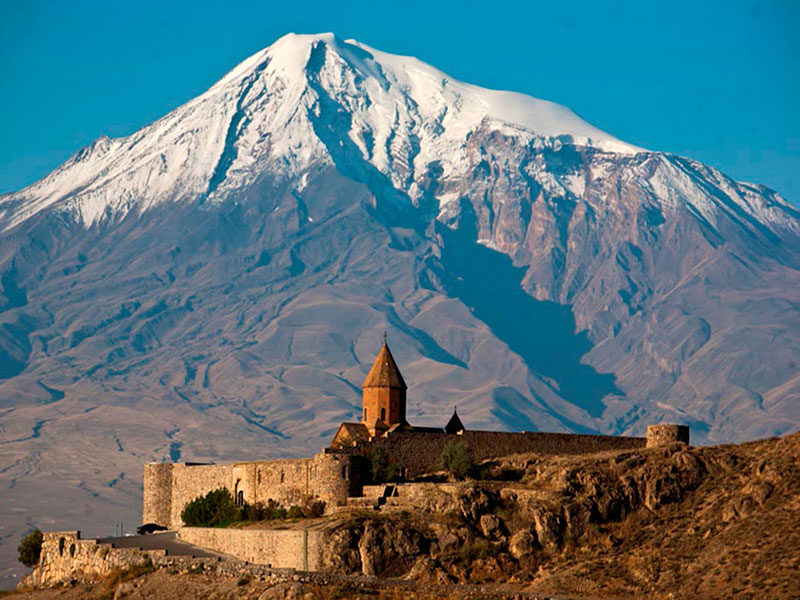
Beyond its historical importance, Khor Virap is also famous for offering the closest and most stunning views of Mount Ararat, Armenia’s national symbol. The monastery sits in a wide, open landscape surrounded by vineyards and fields, creating a peaceful and picturesque setting. On clear days, the view of the snow-capped mountain rising behind the monastery is unforgettable.

Khor Virap'snotability as a monastery and pilgrimage site is attributed to the fact that Gregory the Illuminator was initially imprisoned here for 13 years by King Tiridates III of Armenia. Saint Gregory subsequently became the king's religious mentor, and they led the proselytizing activity in the country. In the year 301, Armenia was the first country in the world to be declared a Christian nation. A chapel was initially built in 642 at the site of Khor Virap by Nerses III the Builder as a mark of veneration to Saint Gregory. Over the centuries, it was repeatedly rebuilt. In 1662, the larger chapel known as the "St. Astvatsatsin" (Holy Mother of God) was built around the ruins of the old chapel, the monastery, the refectory and the cells of the monks. Now, regular church services are held in this church. It is one of the most visited pilgrimage sites in Armenia.

A visit to Khor Virap is not just a sightseeing stop — it is a journey into the roots of Armenian identity, faith, and resilience, making it an essential destination for anyone exploring Armenia.


Noravank Monastery – Armenia’s Jewel Among Red Cliffs

Discover one of Armenia’s most beautiful medieval monasteries hidden within spectacular canyon landscapes.

Noravank Monastery is one of the most stunning historical and architectural landmarks in Armenia, located in a narrow gorge surrounded by dramatic red rock cliffs in the Vayots Dzor region. Situated about 120 km southeast of Yerevan, the monastery is famous for its breathtaking natural setting and unique medieval Armenian architecture.

The name “Noravank” translates as “New Monastery” in Armenian. The complex was founded in the 13th century and quickly became an important religious, cultural, and educational center of medieval Armenia. Over the centuries, it was closely connected with Armenian princes, scholars, and artists.

One of the most remarkable structures within the complex is the two-story Surb Astvatsatsin Church, built in 1339 by the famous Armenian architect and sculptor Momik. The church is especially known for its narrow exterior staircase leading to the upper level entrance, creating one of the most recognizable architectural features in Armenia.

Noravank is also admired for its detailed stone carvings and intricately designed khachkars, traditional Armenian cross-stones. The artistic decorations on the walls and entrances demonstrate the extraordinary craftsmanship of medieval Armenian artisans and remain well preserved even after centuries.

The surrounding canyon adds greatly to the beauty and atmosphere of the monastery. Towering red cliffs, unique rock formations, and changing sunlight throughout the day create spectacular scenery that attracts photographers and nature lovers from around the world. The area is also home to diverse wildlife and rare bird species.

Nearby visitors can explore the famous Areni wine region, known for its ancient winemaking traditions dating back thousands of years. The nearby Areni Cave, where some of the world’s oldest known winemaking artifacts were discovered, makes the region even more historically significant.

Despite earthquakes and periods of destruction throughout history, Noravank Monastery has remained one of Armenia’s most treasured cultural monuments and continues to be an active symbol of Armenian heritage and spirituality.

A visit to Noravank Monastery is more than just a historical excursion — it is an unforgettable experience combining medieval architecture, dramatic natural landscapes, and the timeless spirit of Armenia.


Highlights

1) Comfortable vehicles with air conditioning

2) Pick up and drop off at your hotel

3) Bottled water provided

4) Free Wi-Fi on board

5) Free cancellation at any time

6) Starting time and place: at request

Tour price for various courses

Tour - c9e6

Other Destinations

Tour on map