1) Comfortable vehicles with air conditioning
2) Pick up and drop off at your hotel
3) Bottled water provided
4) Free Wi-Fi on board
5) Free cancellation at any time
6) Starting time and place: at request
Tour price for various courses
Tour - d4c2
Discover one of Armenia’s most extraordinary spiritual and architectural landmarks surrounded by dramatic mountain landscapes.
Geghard Monastery is one of the most famous historical and religious sites in Armenia, located in the scenic Azat River Gorge about 40 km southeast of Yerevan. Surrounded by towering cliffs and rugged mountains, the monastery is renowned for its unique rock-cut architecture and spiritual atmosphere.
The name “Geghard” means “spear” in Armenian and refers to the legendary spear that, according to tradition, pierced the side of Jesus Christ during the crucifixion. The relic was brought to Armenia by the Apostle Thaddeus and was once kept at the monastery for centuries, giving the complex its historical and religious importance.
Although a monastery existed here from early Christian times, most of the current complex was built during the 12th and 13th centuries. What makes Geghard truly unique is that many of its churches and chapels were carved directly into the surrounding rock cliffs. These cave-like chambers feature detailed stone carvings, arches, and cross-stones that demonstrate the exceptional craftsmanship of medieval Armenian architects.
One of the most remarkable parts of the monastery is the main rock-cut church, where natural light enters through openings in the ceiling, creating a mystical and peaceful atmosphere. The acoustics inside the chambers are extraordinary, and visitors often experience traditional Armenian spiritual music performed within the monastery walls.
Geghard was an important center of learning, religion, and pilgrimage during medieval times. Monks living in the monastery carved living quarters, prayer rooms, and chapels into the mountain itself, turning the complex into a self-contained spiritual center hidden within nature.
The surrounding landscape adds greatly to the beauty of the site. Steep canyon walls, flowing mountain streams, and green hills create a breathtaking natural environment that perfectly complements the monastery’s ancient stone structures. Nearby visitors can also explore traditional markets and local food stalls offering Armenian sweets and handmade products.
Recognized as a UNESCO World Heritage Site, Geghard Monastery is considered one of the finest examples of medieval Armenian architecture and remains one of the country’s most visited attractions.
A visit to Geghard Monastery is more than just a historical excursion — it is an unforgettable journey into Armenia’s spiritual heritage, mountain landscapes, and centuries-old architectural traditions.
Discover the only surviving Greco-Roman colonnaded temple in Armenia surrounded by breathtaking mountain scenery.
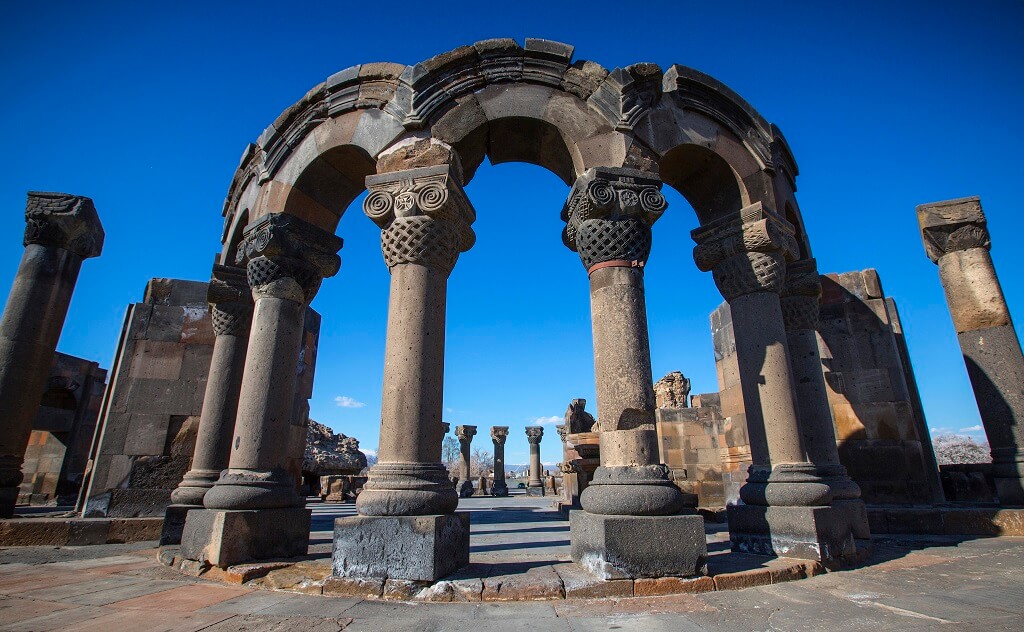
The Temple of Garni is one of Armenia’s most iconic historical landmarks and the only preserved pagan temple in the entire Caucasus region. Located about 30 km east of Yerevan in the village of Garni, the temple stands dramatically on the edge of a deep gorge overlooking the stunning Azat River valley.
Built in the 1st century AD during the reign of King Tiridates I, the temple was dedicated to Mihr, the Armenian sun god associated with light and strength. Its classical architectural style, featuring elegant columns and symmetrical design, reflects strong Greco-Roman influence and makes it unique among Armenian historical monuments.
After Armenia adopted Christianity in the early 4th century, many pagan temples across the country were destroyed. However, the Temple of Garni survived, likely because it was transformed into a royal summer residence and retreat for Armenian nobility.
The temple was severely damaged by a powerful earthquake in 1679 and remained in ruins for centuries. During the Soviet period, extensive restoration work was carried out, and the structure was carefully reconstructed using many of the original stones. Today, visitors can admire the restored temple much as it would have appeared in ancient times.
One of the most remarkable features near Garni is the spectacular Symphony of Stones, a natural basalt rock formation located below the temple in the gorge. The perfectly shaped volcanic columns resemble giant organ pipes and are considered one of Armenia’s most impressive natural wonders.
The Garni area is also known for its rich cultural traditions and local hospitality. Visitors often have the opportunity to watch the preparation of traditional Armenian lavash, a thin flatbread baked in underground tonir ovens and recognized by UNESCO as part of Armenia’s cultural heritage.
Surrounded by mountains, cliffs, and scenic landscapes, the Temple of Garni combines history, culture, and nature in one unforgettable destination. Its unique atmosphere and architectural beauty make it one of the most visited attractions in Armenia.
A visit to the Temple of Garni is more than just exploring an ancient monument — it is a journey into Armenia’s pre-Christian history and a rare opportunity to experience a surviving piece of classical antiquity in the Caucasus region.
1) Comfortable vehicles with air conditioning
2) Pick up and drop off at your hotel
3) Bottled water provided
4) Free Wi-Fi on board
5) Free cancellation at any time
6) Starting time and place: at request
Tour price for various courses
Tour - d4c2

Excursion to the beautiful and ancient monasteries of Saghmosavank and Hovhannavank
Tour - b4e2
Transfer To Tbilisi and on the way excursion to the beautiful and ancient monastery of Haghartsin or Goshavank or natural climatic lake Parz.
Tour - e1a9
Excursion to the beautiful and ancient monasteries of Khor Virap and Noravank also Mountain Spa Town Jermuk.
Tour - d0f2Tour on map